
Interview for the Boynes Artist Award
On October 7, 2025, one of Australia's largest art competitions, Boynes, published an interview with Gaya Lastovjak as the second-place winner in the 12th edition of the competition. It addressed issues related to the artist's technique, the themes of her paintings, her achievements, as well as tips for aspiring artists. The interview was conducted by the founder of the competition, Chantal Boynes.
 Who are you?
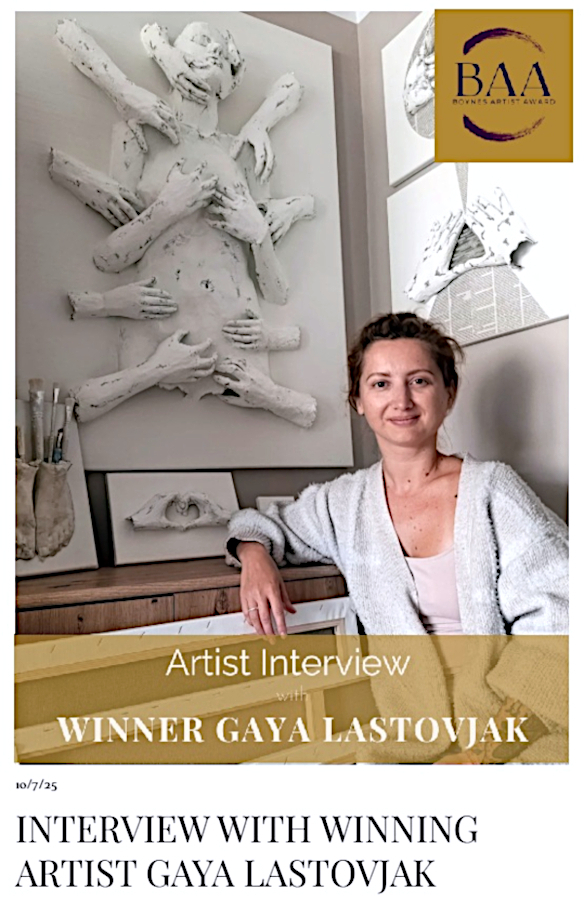
My name is Gaya Lastovjak. I was born in 1987 in Lithuania but spent most of my life in Poland. Currently, I work and live in Krakow. I consider myself as a contemporary figurative artist, because I do not limit myself to a specific field of art, such as painting, sculpture or happenings, they are all important to me and they are all connected by one subject – human. Most often, however, I focus on creating three-dimensional paintings using my own technique, combining paper mache, canvas, and oil paint, supplemented from time to time with new elements such as rope, moss or metal mesh, which enrich the meaning of the works. The departure from the traditional range of colors in favor of white allows for perfect accentuation of light and shade, which changes with the time of day. My works balance between painting and sculpture, giving both disciplines a new dimension. Although I hold a master's degree in art history, I have based my artistic development on self-directed learning complemented by intensive searches for my own artistic language, inspired by observing everything created by human beings.
What inspired you to utilize mixed media as medium?
When I was young, I was interested in various artistic techniques, but I was most fascinated by sculpture as a way of shaping form, and painting, because I really enjoy holding a brush and applying paint to the canvas. Once I took an art class that used papier mache. I really liked the material. It occurred to me then that paper sculptures could also be easily shaped and painted. So I decided to combine both disciplines and artistic techniques into one. Mixed media also offers a wide range of possibilities when it comes to easily introducing new, interesting materials, which allows me to develop my artistic skills.
How would you describe your work?
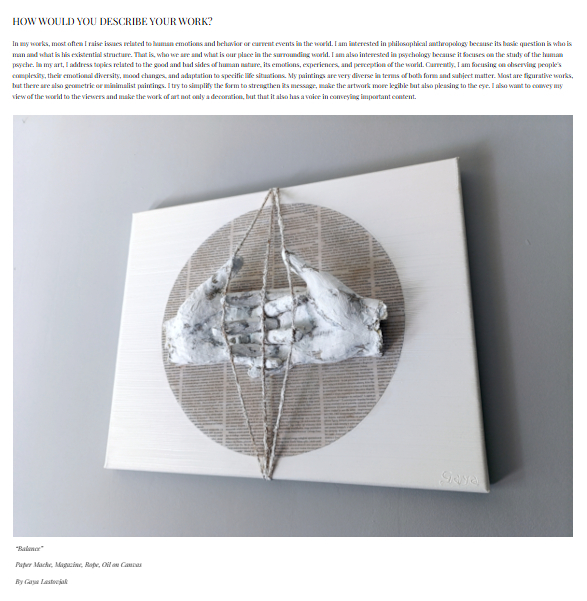
In my works, most often I raise issues related to human emotions and behavior or current events in the world. I am interested in philosophical anthropology because its basic question is who is man and what is his existential structure. That is, who we are and what is our place in the surrounding world. I am also interested in psychology because it focuses on the study of the human psyche. In my art, I address topics related to the good and bad sides of human nature, its emotions, experiences, and perception of the world. Currently, I am focusing on observing people's complexity, their emotional diversity, mood changes, and adaptation to specific life situations. My paintings are very diverse in terms of both form and subject matter. Most are figurative works, but there are also geometric or minimalist paintings. I try to simplify the form to strengthen its message, make the artwork more legible but also pleasing to the eye. I also want to convey my view of the world to the viewers and make the work of art not only a decoration, but that it also has a voice in conveying important content.

Can you discuss the inspiration and thought process behind your winning work?
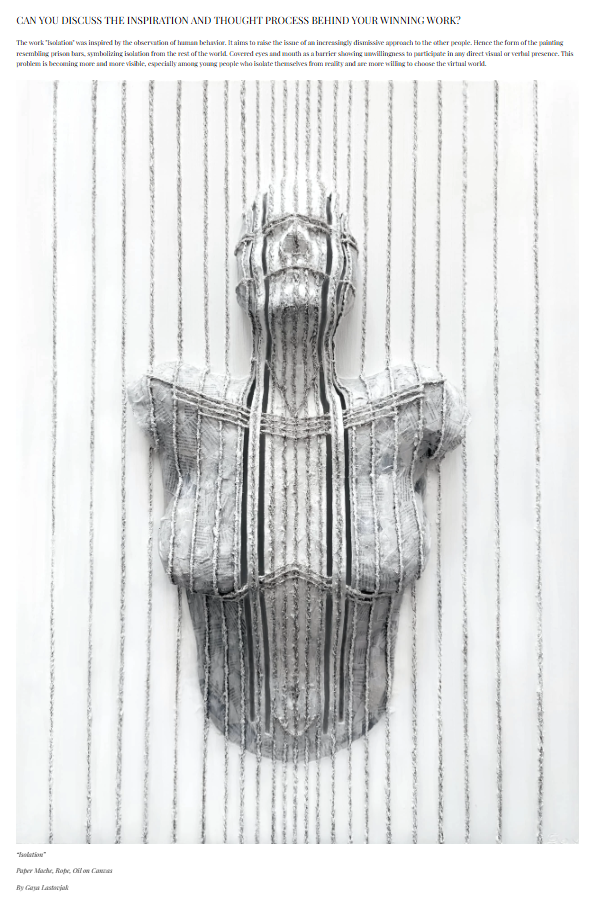
The work "Isolation" was inspired by the observation of human behavior. It aims to raise the issue of an increasingly dismissive approach to the other people. Hence the form of the painting resembling prison bars, symbolizing isolation from the rest of the world. Covered eyes and mouth as a barrier showing unwillingness to participate in any direct visual or verbal presence. This problem is becoming more and more visible, especially among young people who isolate themselves from reality and are more willing to choose the virtual world.
Can you walk us through the technical steps of creating your winning painting?
To create this work, I used plaster casts of various body parts. Using these, I created positives of the paper mache forms and assembled them into a single piece. This time, I decided to also place the rope on the canvas, thus achieving the effect of prison bars. The silhouette also has longitudinal stripes cut out. This was a demanding process, as I cut the stripes with a thin paper knife, and paper mache is very hard once dried. I only applied a glaze to part of the silhouette to reveal the newspapers underneath. Finally, the entire work was covered with a thick layer of oil paint, as is the case with all my works.
Interview by Chantal Boynes
Full interview [click here]

Wywiad dla Boynes Artist Award

7 października 2025 roku, jeden z największych australijskich konkursów artystycznych Boynes opublikował wywiad z Gayą Lastovjak jako zwyciężczynią drugiego miejsca w XII edycji konkursu. Poruszono w nim kwestie związane z techniką, tematyką obrazów artystki, jej osiągnięć a także wskazówkami dla początkującego artysty. Wywiad przeprowadziła założycielka i przewodnicząca konkursu - Chantal Boynes.
Co zainspirowało Cię do wykorzystania techniki mieszanej (mixed media) jako medium?
 Jak opisałabyś swoją pracę/twórczość?


Gaya Lastovjak
The art of emotions trapped in white
Copyright © 2026 GAYA LASTOVJAK