
Interview for the Kooness Magazine
On June 18, the Italian art magazine The Kooness published an interview with Gaya Lastovjak entitled "The Dual Nature of Humanity" in which the artist tells readers about her art. This publication discusses the issues of inspiration, the importance of art in the artist's life, tackling social issues, plans for the future and the value of Gaya's art. The full interview is presented below. Due to changes in the publisher's archives, the original feature is no longer available on the Kooness website.
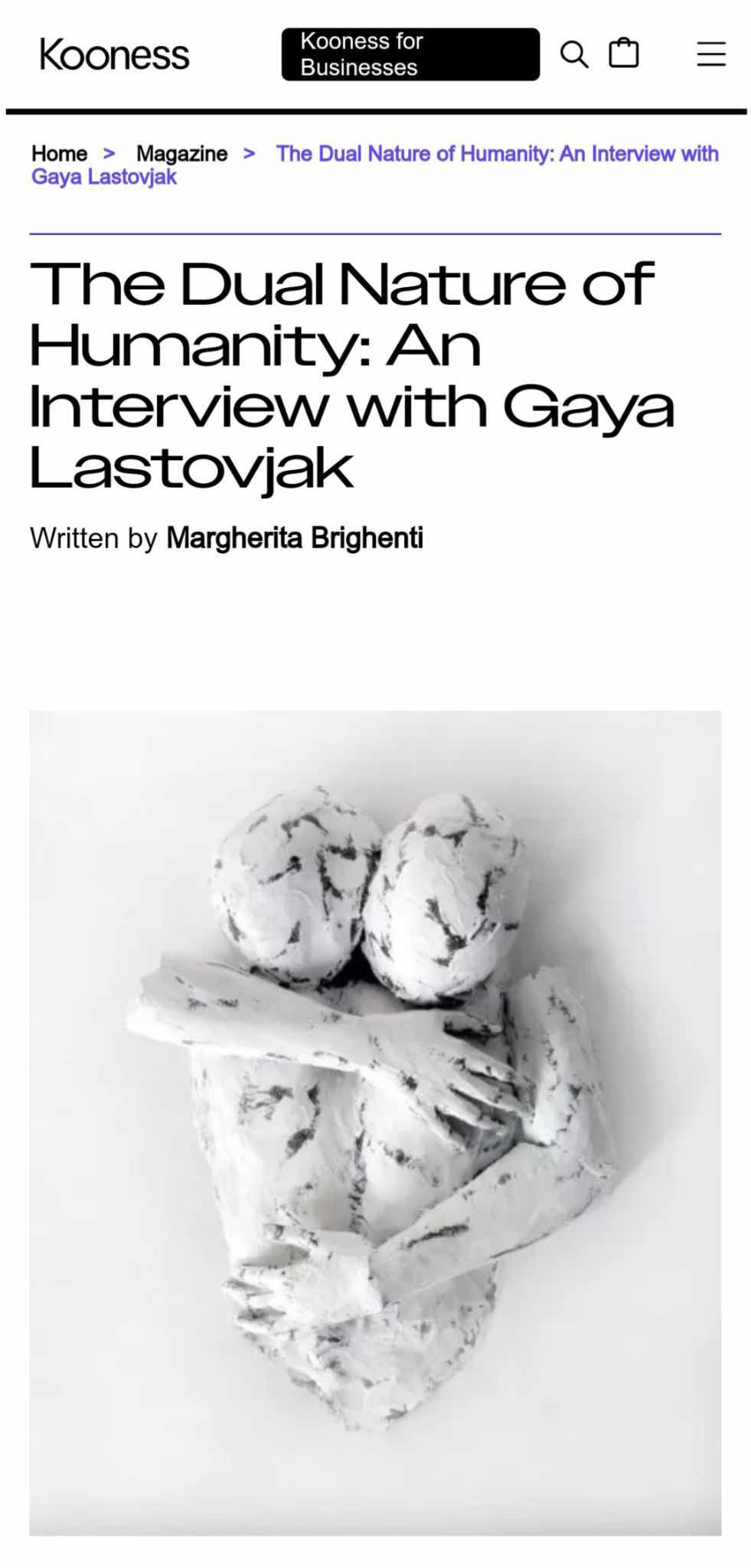 What does your art mean to you?
Art is a way for me to express myself and my view of the world. What fascinates me the most is the human being and the issues related to him. I observe people very carefully, and I am amazed by the diversity and multitude of emotions they hide. When I create, I try to show what I feel, my point of view on what the world and the human beings in it can be like. All my life I have been wondering about the mechanisms that govern our good and bad sides. Why do people behave the way they do, and why do some choose good and others evil? That is why my art most often deals with the subject of the dualistic nature of man. I also show personal worries and fears, sometimes nice associations and positive memories. My art is the materialization of everything that is in my observations, thoughts, mind and heart. I think that many artists would answer this question similarly to me because art is subjective and represents something different but personal for everyone. For me, art is a voice in the world around us, it is part of me.
What Inspires You?
I am inspired by the contradictions of human character, behavior, and reactions. These are the central themes of my paintings. However, inspiration also comes from everything created by human hands—especially music, books, films, architecture, photography, and fine art. Some time ago, I drew inspiration from artists such as Vadim Stein and Annie Leibovitz, as well as fashion photography. For instance, my painting "Mystery" was based on a photograph by Pierre Debusschere for Vogue. A few works were inspired by ancient art, but usually, the compositions appear in my mind spontaneously. In fact, I stopped looking for ready-made patterns a long time ago. Having seen so many examples of visual arts throughout my life, they have left a lasting impression, allowing my imagination to generate fully-formed ideas for new paintings. The resilience of certain renowned artists is also important to me. The art world is challenging, and in a landscape so rich in talent, gaining recognition is difficult. In such moments, I am inspired by the attitude of artists like Frida Kahlo or L. S. Lowry, who never gave up despite life's hardships. Ultimately, though, it is the human being—their everyday struggles and the emotions tied to them—that inspires me most.
How Can Your Work Affect Societal Issues?
Social problems are phenomena that must be discussed in order to find solutions and improve society. Violence, war, and discrimination are topics I address in my work, particularly those highlighting the darker side of human nature. I strive to depict despair; hence the "torn bodies" that express a cry for help. My painting "Pain" is intended to draw attention to those who suffer, especially women who are victims of aggression or terror. The artwork depicts a wounded, incomplete female body torn apart by aggressive hands, symbolizing violence and hatred. I wanted to raise the issue of physical suffering and highlight that in many countries, women still lack fundamental rights and face persecution. My focus is not just on gender equality, but on the basic necessity of treating women as human beings rather than inferiors. However, my work also contains an element of hope—the hand extended in a gesture of consolation from the upper right. This gesture expresses my belief that we should all fight for ourselves and a better tomorrow, while supporting one another. The paintings "Collusion" and "Connivance" criticize lies and deceit, some of the worst human traits. Both works show figures plotting and conspiring. In contrast, "Unbreakable" speaks of war and the unyielding human spirit; the figure stands upright despite torn arms and a body bound with rope. It is a composition that shows the drastic effects of war while glorifying the heroic attitude of those who refuse to surrender. I hope my way of discussing difficult topics captures viewers' attention and encourages empathy. I want my small voice to be heard and to inspire positive change. On a practical level, I participate in charity auctions and support children’s hospitals and animal shelters. I also use eco-friendly materials (certified folders, envelopes, and business cards) to reduce my environmental impact. If everyone tried to be a better, kinder, and more helpful person, the world would truly become a better place.
What factors influence the value of your works?
Many factors influence the value of my work. First of all, I developed my artistic language. This is a very important issue. I also have my own, original technique, the secrets of which only I know, i.e. specific materials, proportions and durability. Another aspect of the value of my works is artistic awards. I started taking part in competitions in 2021. In the period 2021-2023, I won 29 international awards and nominations, which significantly increased the value of my work. The same can be said about exhibitions. I have exhibited my paintings in Italy, Austria, Spain, Netherlands, Poland, Portugal, Monaco and other countries around the world. The most important exhibitions in which I participated were the 59th Venice Biennale, the International Contemporary Art Fair in Monaco, the exhibition at the Venanzo Crocetti Museum in Rome and the Van Gogh Gallery in Madrid, the VIIIth edition of RAW (Rome Art Week) at the Palazzo della Cancelleria Vaticana, the XIVth Florence Biennale, Warsaw Art Fair and many others. It is also worth mentioning that the price of a specific painting depends on its achievements. Work that has won awards in competitions or been shown at prestigious artistic events will certainly be more expensive. The last issue is technique. Since it is complicated and time-consuming, only a few paintings are created each year; I made a maximum of fourteen works in one year (it was 2021). In 2023, I only did seven. It is also worth noting that I use high-quality materials and some of the most expensive oil paints on the market. I do not make replicas, each painting is different and I care about its uniqueness.
What Are Your Ultimate Career Goals?
I want my art to reach a wider audience and provoke reflection on the self and the world. I plan to continue creating innovative, engaging works that surprise and encourage viewers to interact with art. My goal is to show my work in prestigious galleries and major global art events. My dream is to one day see my work at the Tate Modern, MoMA, or at a Sotheby’s auction. Ultimately, I aim to continue winning awards, increasing the value of my art, and developing my craft through hard work and constant evolution.
Interview by Margherita Brighenti

Wywiad dla czasopisma The Kooness
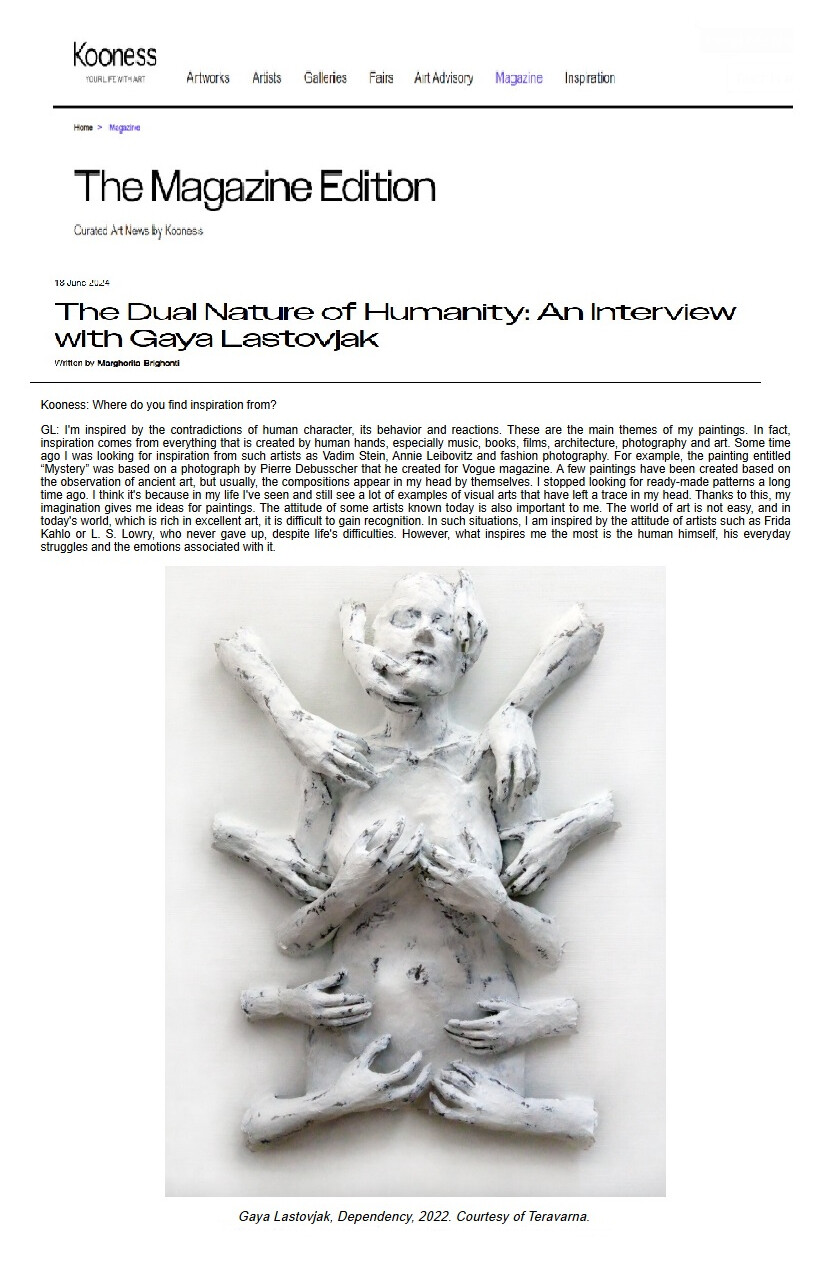 18 czerwca włoski magazyn artystyczny The Kooness opublikował wywiad z Gayą Lastovjak zatytułowany „Podwójna natura człowieczeństwa”, w którym artystka opowiada czytelnikom o swojej sztuce. W publikacji tej poruszane są kwestie inspiracji, znaczenia sztuki w jej życiu, kwestie społeczne, plany na przyszłość oraz temat wartości obrazów Gayi. Poniżej znajduje się cały wywiad, ponieważ ze względu na zmiany w archiwum wydawcy, oryginalna publikacja niestety nie jest już dostępna na stronie Kooness.
Co sztuka oznacza dla Ciebie?
Sztuka jest dla mnie sposobem na wyrażenie siebie i swojego spojrzenia na świat. Najbardziej fascynuje mnie człowiek i kwestie z nim związane. Bardzo uważnie obserwuję ludzi i zadziwia mnie różnorodność i mnogość emocji, jakie kryją. Kiedy tworzę, staram się pokazać to, co czuję, swój punkt widzenia na to, jak może wyglądać świat i żyjący w nim ludzie. Przez całe życie zastanawiałam się nad mechanizmami rządzącymi naszymi dobrymi i złymi cechami. Dlaczego ludzie zachowują się tak a nie inaczej, dlaczego niektórzy wybierają dobro, a inni zło? Dlatego moja twórczość najczęściej porusza temat dualistycznej natury człowieka. Pokazuję także osobiste zmartwienia i lęki, czasem miłe skojarzenia i pozytywne wspomnienia. Moja sztuka to materializacja wszystkiego co znalazło się w kręgu moich obserwacji ale także umyśle i sercu. Sądzę, że wielu artystów odpowiedziałoby na to pytanie podobnie jak ja, ponieważ sztuka jest subiektywna i dla każdego reprezentuje coś innego, ale osobistego. Sztuka jest dla mnie głosem w otaczającym nas świecie, jest częścią mnie.
Co Cię inspiruje?
Inspirują mnie sprzeczności ludzkiego charakteru, zachowania i reakcje. Są to główne motywy moich obrazów. Jednak w rzeczywistości inspiracja płynie ze wszystkiego, co zostało stworzone ludzką ręką – szczególnie z muzyki, książek, filmów, architektury, fotografii i sztuki. Jakiś czas temu szukałam inspiracji u takich artystów jak Vadim Stein, Annie Leibovitz oraz w fotografii mody. Na przykład obraz zatytułowany „Tajemnica” powstał na podstawie fotografii Pierre’a Debusschere’a, którą stworzył dla magazynu Vogue. Kilka prac powstało w oparciu o obserwację sztuki antycznej, ale zazwyczaj kompozycje pojawiają się w mojej głowie same. Właściwie już dawno przestałam szukać gotowych wzorców. Myślę, że wynika to z faktu, iż w swoim życiu widziałam i nadal widzę wiele przykładów sztuk wizualnych, które zostawiły ślad w mojej pamięci. Dzięki temu wyobraźnia podsuwa mi gotowe pomysły na obrazy. Ważna jest dla mnie również postawa niektórych znanych dziś artystów. Świat sztuki nie jest łatwy, a w dzisiejszych czasach, tak bogatych w doskonałą twórczość, trudno o uznanie. W takich sytuacjach inspiruje mnie postawa artystów takich jak Frida Kahlo czy L. S. Lowry, którzy nigdy się nie poddali, mimo życiowych trudności. Jednak tym, co inspiruje mnie najbardziej, jest sam człowiek, jego codzienne zmagania i związane z tym emocje.
W jaki sposób Twoja praca może pomóc lub wpłynąć na problemy społeczne?
Problemy społeczne to częste zjawisko, o którym trzeba rozmawiać, starając się znaleźć rozwiązania i poprawić sytuację w społeczeństwie. Przemoc, wojny, dyskryminacja – to tematy, które poruszam w swoich pracach ukazujących złą stronę ludzkiej natury. Staram się pokazać rozpacz, stąd „rozdzierane ciała” wyrażające wołanie o pomoc – jak w przypadku obrazu „Ból”, który ma zwrócić uwagę widza na problem osób cierpiących, zwłaszcza kobiet będących ofiarami agresji lub terroru. Dzieło ukazuje zranione, niekompletne kobiece ciało rozrywane przez agresywne dłonie symbolizujące przemoc i nienawiść. Poprzez swoją pracę chciałam nie tylko poruszyć temat fizycznego cierpienia kobiet, ale także zwrócić uwagę na fakt, że w dzisiejszych czasach w wielu krajach kobiety wciąż nie mają swoich praw, są prześladowane i poniżane. Nie mam na myśli walki o równouprawnienie płci, lecz o traktowanie kobiet jako istot ludzkich, a nie kogoś gorszego. Mój obraz zawiera również element nadziei – jest nim dłoń wyciągnięta w geście pocieszenia z górnej prawej strony. Tym gestem chciałam wyrazić swój głos mówiący, że wszyscy powinniśmy walczyć o siebie i nasze lepsze jutro, a także wspierać się nawzajem. Obrazy „Zmowa” i „Pobłażliwość” krytykują kłamstwo i podstęp, jedne z najgorszych cech ludzkiego charakteru. Obie prace przedstawiają dwie postacie, które spiskują, planują coś złego, są w zmowie. Z kolei „Niezłomny” opowiada o wojnie i nieugiętej walce ludzi, dlatego postać stoi wyprostowana mimo wyrwanych ramion i ciała skrępowanego liną. To kompozycja ukazująca drastyczne skutki, ale jednocześnie sławiąca heroiczną postawę człowieka, który się nie poddaje. Mam nadzieję, że mój sposób omawiania trudnych tematów przyciągnie uwagę widzów i skłoni ich do większej empatii wobec innych. Chcę, aby mój skromny głos został usłyszany i by ludzie doświadczyli zmiany na lepsze. Czasami biorę udział w aukcjach charytatywnych, wspieram finansowo chore dzieci lub schroniska dla zwierząt. Używam materiałów ekologicznych (certyfikowane teczki, koperty na podziękowania, wizytówki), aby ograniczać zanieczyszczanie środowiska. Gdyby każdy przynajmniej starał się być lepszym człowiekiem, bardziej pomocnym i milszym dla innych, świat również stałby się lepszym miejscem.
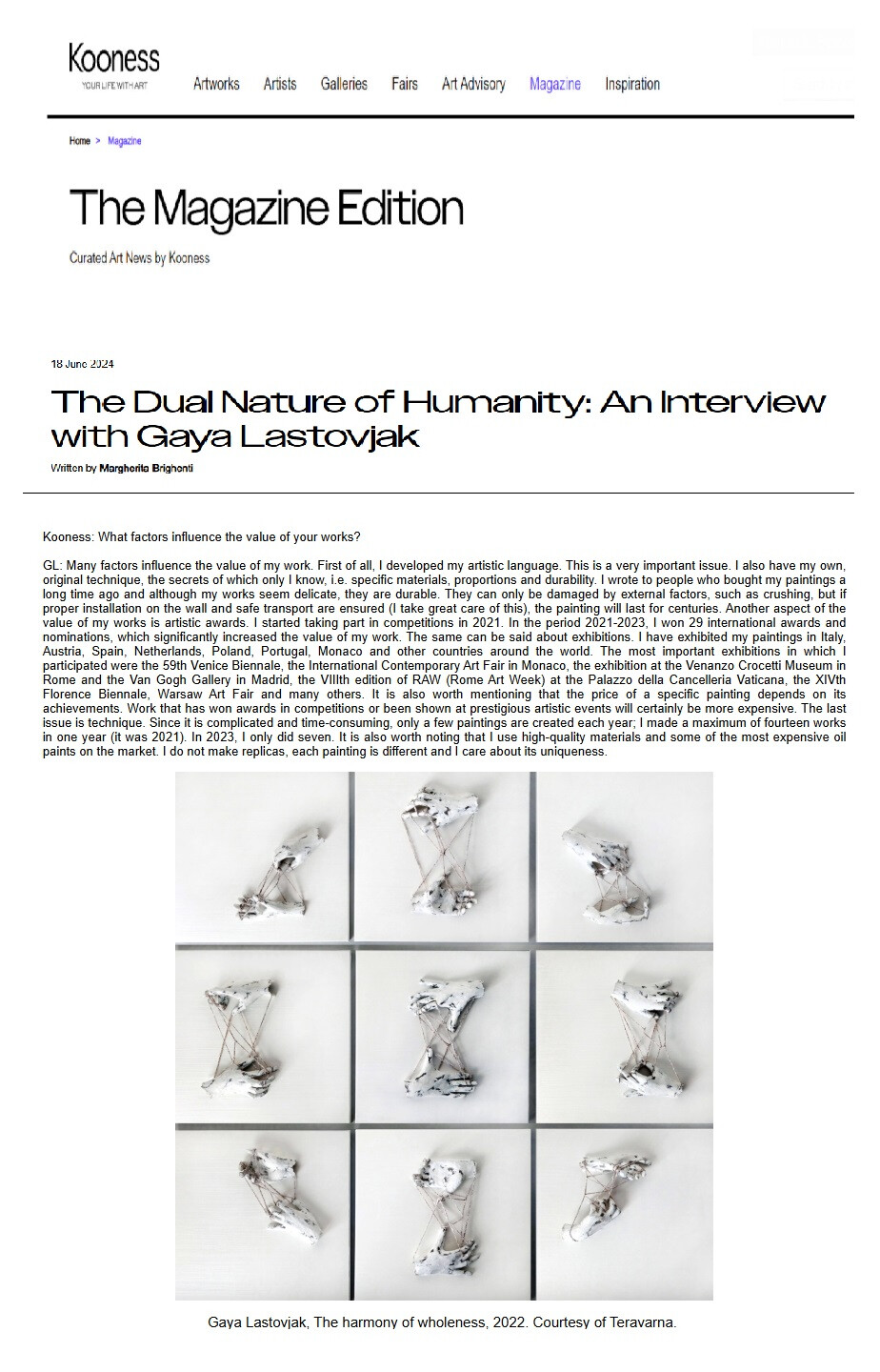 Jakie czynniki wpływają na wartość Twojej sztuki?
Na wartość mojej sztuki wpływa wiele czynników. Przede wszystkim rozwinęłam swój język artystyczny. To bardzo ważna kwestia. Posiadam także własną, autorską technikę, której sekrety znam tylko ja, czyli konkretne materiały i proporcje. Kolejnym aspektem wartości moich prac są nagrody artystyczne. Zaczęłam brać udział w konkursach od 2021 roku. W latach 2021-2023 zdobyłam 29 międzynarodowych nagród i nominacji, co znacząco podniosło wartość moich obrazów. To samo można powiedzieć o wystawach. Brałam udział w wystawach we Włoszech, Austrii, Hiszpanii, Holandii, Polsce, Portugalii, Monako i innych krajach na całym świecie. Do najważniejszych wystaw należą: 59te Biennale w Wenecji, Międzynarodowe Targi Sztuki Współczesnej w Monako, wystawa w Muzeum Venanzo Crocetti w Rzymie i Galerii Van Gogha w Madrycie, VIII edycja RAW (Rome Art Week) w Palazzo della Cancelleria Vaticana, XIV Biennale we Florencji, Warszawskie Targi Sztuki i wiele innych. Warto również wspomnieć, że cena konkretnego obrazu zależy od jego osiągnięć. Prace, które zdobyły nagrody w konkursach lub były pokazywane na prestiżowych wydarzeniach artystycznych, z pewnością będą droższe. Ostatnią kwestią jest technika. Ponieważ jest skomplikowana i czasochłonna, rocznie powstaje zaledwie kilka obrazów. W ciągu jednego roku maksymalnie wykonałam czternaście prac. W 2023 roku wykonałam już tylko siedem. Warto również dodać, że używam wysokiej jakości materiałów i jednych z najdroższych farb olejnych na rynku. Nie wykonuję replik, każdy obraz jest inny i niepowtarzalny.
Jakie są Twoje ostateczne cele zawodowe?
Chciałabym, aby moja sztuka docierała do szerszej publiczności, skłaniała ludzi do refleksji nad sobą i otaczającym ich światem. Planuję tworzyć innowacyjne, bardzo interesujące prace, pozytywnie zaskakiwać i zachęcać do interakcji ze sztuką. Pragnę pokazywać swoje prace w prestiżowych galeriach i na ważnych wydarzeniach artystycznych. Moim marzeniem jest pewnego dnia pojawić się w Tate Modern, MoMA lub na aukcji w Sotheby's. Oczywiście zdobywać kolejne nagrody, zwiększać wartość mojej sztuki, ciężko pracować i cały czas się rozwijać.
Wywiad przeprowadziła Margherita Brighenti

Gaya Lastovjak
The art of emotions trapped in white
Copyright © 2026 GAYA LASTOVJAK